Stridor at rest, increasing retractions, nasal flaring, or rising respiratory rate — notify the provider now; anticipate racemic epinephrine.
Before you read
Test yourself first: 3 questions
Question 1 of 3
A nurse is caring for an unimmunized infant diagnosed with pertussis (whooping cough). Which clinical manifestation is characteristic of the paroxysmal stage?
Answer: A. During the paroxysmal stage of pertussis, the child has severe coughing fits often ending in a high-pitched inspiratory whoop, and infants may become cyanotic or apneic. A barking cough indicates croup, and the other findings are not specific to the paroxysmal stage of pertussis.
Question 2 of 3
A 2-year-old is admitted with a barking, seal-like cough, inspiratory stridor, and a hoarse voice that worsen at night. Which condition does the nurse suspect?
Answer: B. The classic barking or seal-like cough with inspiratory stridor and hoarseness is the hallmark of croup (laryngotracheobronchitis), which causes upper-airway edema below the vocal cords.
Question 3 of 3
A 2-year-old is brought to the emergency department with a barking, seal-like cough and inspiratory stridor that worsened at night. The nurse recognizes these findings as characteristic of which condition?
Answer: B. Laryngotracheobronchitis (croup) classically presents with a barking, seal-like cough and inspiratory stridor, often worse at night. Epiglottitis causes drooling and tripod posture; pertussis causes a whooping cough; asthma causes expiratory wheezing.
Keep the streak going with more questions like these, each with a full rationale.
What is croup?
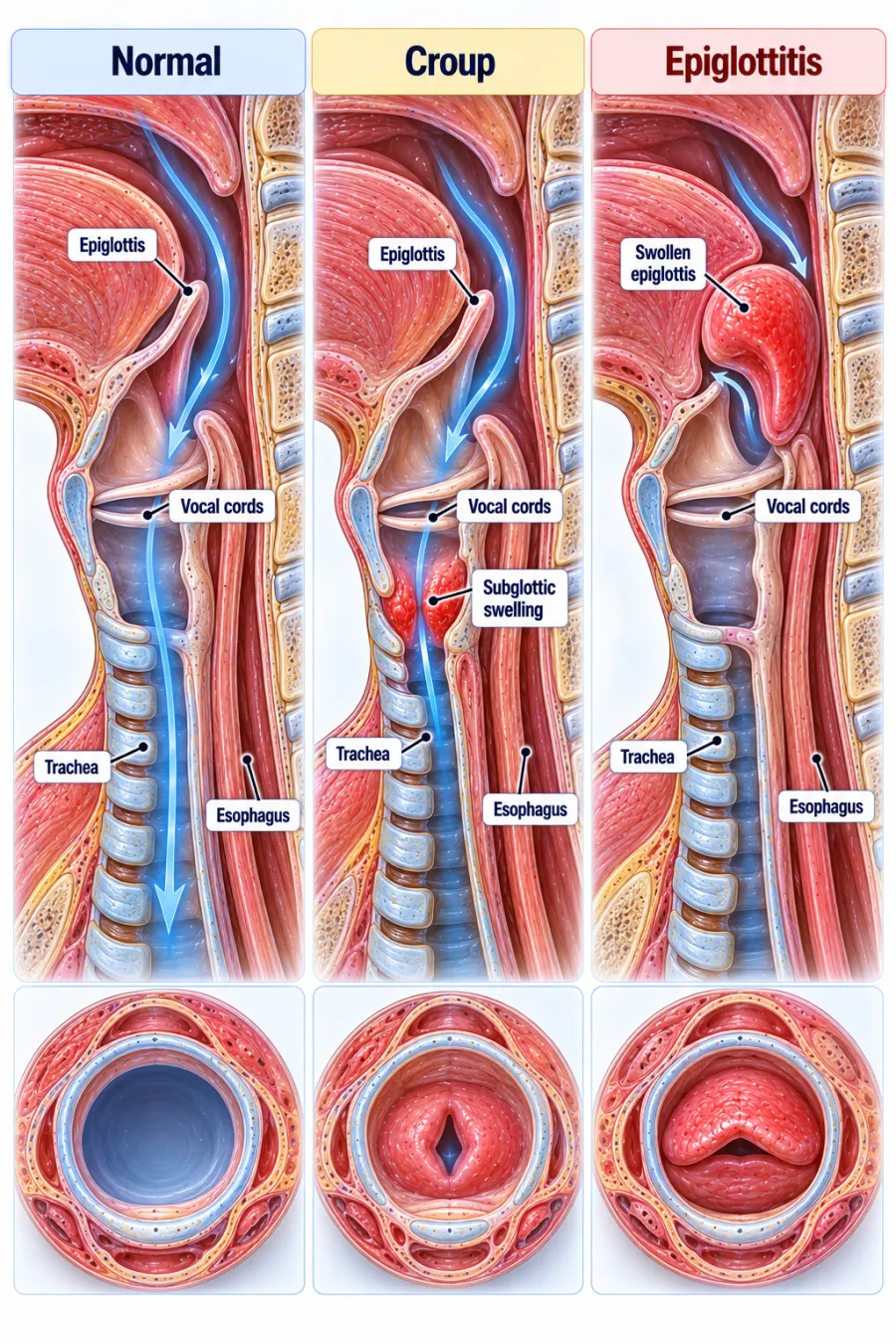
It often starts like a cold. Swelling below the vocal cords (subglottic) narrows an airway that is already small in young children. This produces the classic barking, seal-like cough, a hoarse voice, and inspiratory stridor. Children 6 months to 3 years are at highest risk. Symptoms are worse at night and usually last about 3–5 days. Most cases are mild and managed at home, but the nurse must spot swelling that is progressing toward airway obstruction.
Croup illustrated
Key points to remember
- Hallmark signs: harsh barking or seal-like cough, hoarseness, and inspiratory stridor.
- Symptoms worsen at night and with crying or agitation.
- Onset is gradual, often after a low-grade fever and cold symptoms.
- The child looks nontoxic and can usually still drink, swallow, and lie flat.
- A neck X-ray may show the steeple sign (subglottic narrowing).
- Stridor at rest, retractions, and restlessness mean the obstruction is getting worse.
- Nursing problems in priority order: ineffective breathing pattern or airway clearance, then anxiety (child and parent), then risk for deficient fluid volume.
Common causes
- Viral (parainfluenza), 6mo–3yr
- Subglottic airway swelling
Signs & symptoms
- Seal-bark cough, worse at night
- Inspiratory stridor, hoarse voice
- Low-grade fever, gradual onset
Nursing priorities
- Keep the child calm and on the parent's lap, because crying and agitation worsen airway obstruction.
- Monitor respiratory rate, stridor, retractions, oxygen saturation, and level of consciousness continuously, because deterioration can be quiet.
- Give dexamethasone as ordered, because it reduces airway swelling.
- Give nebulized racemic epinephrine as ordered for moderate-to-severe stridor and observe for at least 2–3 hours, because symptoms can rebound as it wears off.
- Provide cool humidified air or mist and offer oral fluids, because fluids thin secretions and prevent dehydration.
Labs & values
Worked example
- Cue: A toddler with a barking cough has stridor only when crying. Overnight the stridor is present at rest, with retractions and restlessness.
- Meaning: Airway swelling has progressed from mild to moderate-to-severe croup.
- Action: Keep the child on the parent's lap, notify the provider, and give dexamethasone and nebulized racemic epinephrine as ordered while monitoring oxygen saturation.
- Evaluation: Stridor at rest resolves, oxygen saturation stays 95–100%, and the child is observed at least 2–3 hours with no rebound.
Patient teaching
- Croup is usually worse at night and lasts about 3–5 days. Most children get better at home.
- Use cool night air or a cool-mist humidifier, and sit with your child during coughing spells.
- Keep your child calm and offer small, frequent sips of fluid.
- Go to emergency care right away for noisy breathing at rest, fast or hard breathing, drooling, or bluish color.
Common mistakes
- Thinking a child who has become quiet is improving. Decreased breath sounds and quieting can mean exhaustion.
- Separating the child from the parent or doing procedures that make the child cry, which worsens obstruction.
- Discharging the child right after racemic epinephrine instead of observing at least 2–3 hours for rebound.
- Missing drooling, trouble swallowing, or a toxic appearance, which point to a different and more dangerous airway problem.
Red flags: report now
- Stridor at rest, increasing retractions, nasal flaring, or rising respiratory rate — notify the provider now; anticipate racemic epinephrine.
- Cyanosis, falling oxygen saturation, lethargy, or decreasing level of consciousness — call for immediate help.
- A child who suddenly becomes quiet with decreased breath sounds — likely tiring toward respiratory failure; treat as an emergency.
- Drooling or trouble swallowing — this does not fit croup; escalate immediately and stay with the child.
References
Clinical references for this topic